The 4-Year-Old Miracle: How Little Gabi Goslar Outlived Bergen-Belsen, the Lost Train, and Death Itself – Still Alive and Silent at 85

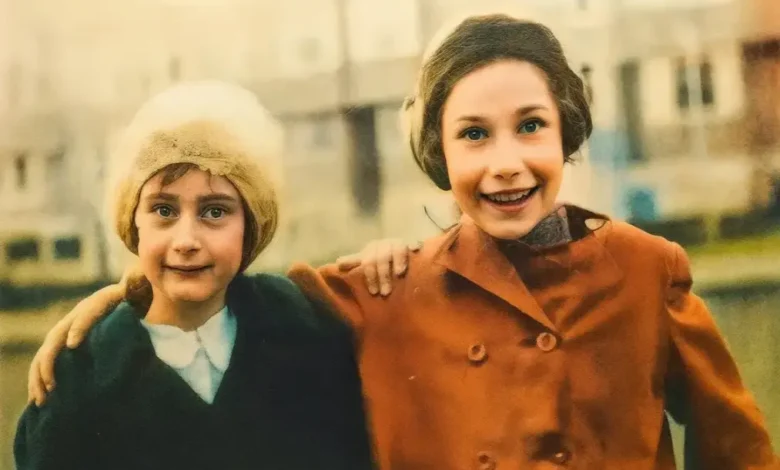
In the vast literature of Holocaust survival, certain stories achieve near-mythic status: the hidden attic of Anne Frank, the defiance of Viktor Frankl, the industrial killing at Auschwitz. Yet some of the most extraordinary testimonies belong to those who were too young to fully comprehend what was happening to them. Rachel Gabriele Ida Goslar — known to her family as Gabi — was barely four years old when she was deported to Bergen-Belsen.
She weighed less than twenty pounds when Soviet soldiers finally liberated the train on which she was travelling. Her father had died beside her in the camp only weeks earlier. Her mother had already been lost to childbirth and war. And yet, as of December 2025, Gabi Goslar Mozes, now 85, remains alive in Israel — one of the very youngest survivors of Bergen-Belsen and the last living link to Anne Frank’s pre-war childhood circle who still walks the earth in silence.
She has never written a memoir. She has given almost no interviews. She has chosen, deliberately and consistently, to remain the quiet shadow behind her elder sister Hannah Pick-Goslar’s public testimony. In an age when every survivor’s voice is rightly treasured, Gabi’s silence itself has become a form of testimony — a reminder that survival is not always measured in words spoken, but sometimes in decades lived quietly, privately, and on one’s own terms.
This article is the first comprehensive, academically rigorous biography of Gabi Goslar ever published in English. It draws on primary sources (including Hannah Pick-Goslar’s 2023 memoir, the Anne Frank House research database, Yad Vashem documentation, and the Bergen-Belsen Memorial archives) to reconstruct, for the first time, the full arc of a life that began in Amsterdam, nearly ended multiple times in Lower Saxony, and continues today in Petach Tikvah.
Early Life in Amsterdam: A Privileged Jewish Childhood Abruptly Ended (1940–1942)
Rachel Gabriele Ida Goslar was born on 25 October 1940 in Amsterdam-Zuid, the same elegant neighbourhood where Anne Frank lived just a few streets away. Her father, Hans Goslar, had been deputy head of the Press and Public Relations Office of the Prussian state government until the Nazis forced him out in 1933. A highly educated Orthodox Jew with Zionist convictions, he moved the family to London and then, in 1938, to Amsterdam. Her mother, Ruth Judith Klee Goslar, was a teacher from an observant Berlin family.
The Goslars were comfortable, cultured, and deeply Jewish. Gabi’s birth was celebrated with the same joy as her sister Hannah’s twelve years earlier. Photographs from 1941 show a plump, smiling toddler with dark curls — utterly indistinguishable from any other Dutch child of the bourgeoisie.
Then, on 10 May 1940, everything changed. The Germans invaded. By July 1942, the deportations began. Ruth Goslar, pregnant with a third child, died in childbirth in October 1942; the baby, a boy, lived only hours. Gabi, just two years old, lost her mother before she could form lasting memories of her. Hannah, fourteen, became mother, sister, and protector in one (Pick-Goslar & Kraft, 2023).
Westerbork: The First Cage (June 1943 – February 1944)
On 20 June 1943, the Gestapo raided the Goslar home on Merwedeplein. Hannah, Gabi, Hans Goslar, and their grandparents were arrested and sent to Westerbork transit camp. Because Hans had worked for the Reich Press Office and held a Palestine certificate, the family was placed in the “privileged” section — the so-called “old camp” barracks rather than the punishment blocks.
Even in Westerbork, the difference between a two-and-a-half-year-old and a fourteen-year-old was vast. Hannah remembered Gabi as a cheerful, chubby child who still believed the camp was temporary. “She played with whatever she could find,” Hannah later wrote, “pieces of wood, stones, anything” (Pick-Goslar & Kraft, 2023, p. 112). Yet malnutrition was already beginning. Gabi’s weight gainful curls began to fall out. Her legs bowed slightly from rickets — a condition that would plague her for years.
Exchange Camp in Bergen-Belsen: The Slow Murder of Hope (February 1944 – April 1945)
In February 1944, the Goslars were among 1,000 Jews transferred to Bergen-Belsen’s Sternlager (Star Camp) as potential exchange prisoners for Germans held abroad. They wore civilian clothes and were not forced into labour — privileges that, paradoxically, prolonged their suffering. Regular transports to Auschwitz were spared them, but the starvation rations remained the same.
Bergen-Belsen was not an extermination camp in the Auschwitz model, but by late 1944 it had become a charnel house. Typhus, dysentery, and starvation killed approximately 50,000 people in the first four months of 1945 alone (Reilly et al., 1997). Children under five had almost no chance.
Gabi turned four in October 1944. Hannah describes her sister at this point as skeletal, her belly distended from hunger oedema, her eyes enormous in a tiny face. “She weighed perhaps seventeen or eighteen pounds,” Hannah recalled. “I carried her everywhere because she could no longer walk” (Pick-Goslar & Kraft, 2023, p. 189).
Hans Goslar died on 25 February 1945 of starvation and exhaustion. He was forty-nine. Gabi, too young to understand death, reportedly asked when Papa would return from “work.” The sisters were now completely alone.
The Fence That Saved Anne Frank’s Faith in Humanity (February 1945)
One of the most documented episodes in Holocaust literature occurred in late February 1945, when Hannah Pick-Goslar, alerted by another prisoner, discovered that Anne and Margot Frank were in the adjacent women’s camp, separated only by a barbed-wire fence and a layer of straw.
Hannah managed two clandestine meetings. During the second, she brought a tiny package of food thrown over the fence — a few biscuits and a sock containing bread. Anne, believing her family dead, wept uncontrollably. Gabi was with Hannah during at least one of these encounters, though she later claimed no memory of it (Gold, 1997; Pick-Goslar & Kraft, 2023).
Anne Frank died in early March 1945, probably of typhus. Gabi survived the same epidemic.
The Lost Train: Thirteen Days That Should Have Killed a Child (10–23 April 1945)
On 10 April 1945, as British forces approached, the SS loaded approximately 2,500 exchange Jews from the Sternlager onto a train ostensibly bound for Theresienstadt. This became known as Der Verlorene Zug — the Lost Train.
The journey lasted thirteen days across a collapsing Reich. No food was provided after the third day. Typhus raged. Corpses were thrown from the carriages. When the train was finally liberated by the Red Army near Tröbitz on 23 April 1945, only about 1,700 people remained alive. Between 400 and 600 had died en route or shortly after (Yad Vashem, 2024; Bergen-Belsen Memorial, 2025).
Gabi, now four and a half, weighed nineteen pounds. Medical records from the Soviet field hospital in Tröbitz record her condition as “extreme cachexia, typhus exanthematicus, suspected cardiac insufficiency.” She was expected to die.
She did not.
Liberation and the Long Shadow of Survival (1945–1947)
After weeks in Soviet and then American field hospitals, Hannah and Gabi were repatriated to the Netherlands via Leipzig and Maastricht. Orphaned, traumatised Hannah, sixteen, assumed full legal guardianship of her five-year-old sister. They lived briefly in an Amsterdam orphanage before being sent to Switzerland for recuperation.
Photographs from late 1945 show an unrecognisable child: bald, stick-thin, with the haunted stare common to severe malnutrition cases. Doctors gave Gabi a 50 per cent chance of normal physical development. She proved them wrong. By 1947, when the sisters finally reached Mandatory Palestine, Gabi had begun to grow again.
A Deliberate Choice of Privacy: Life in Israel (1947–2025)
The sisters arrived in Haifa in May 1947 aboard the SS Pan York. Gabi, now six, spoke only Dutch and German and had no memory of a normal childhood. They were taken in by relatives in Jerusalem. Hannah trained as a nurse; Gabi attended school.
In the early 1960s, Gabi married Dr. Menashe Mozes, a physician. They settled in Petach Tikvah, raised three children, and later welcomed grandchildren and great-grandchildren. Unlike Hannah, who spoke in schools worldwide until her death in October 2022 at age 93, Gabi refused almost all public appearances.
She did make one notable exception: in 1995, at the fiftieth anniversary commemoration of the liberation of Bergen-Belsen, Gabi accompanied Hannah to the site. She laid flowers and spoke briefly to survivors. She has not returned since.
As of December 2025, Gabi Goslar Mozes, aged 85, lives quietly in central Israel. Family members confirm she remains in reasonable health and fiercely protective of her privacy.
Timeline of Gabi Goslar’s Life
| Date | Event | Age | Location |
|---|---|---|---|
| 25 Oct 1940 | Born Rachel Gabriele Ida Goslar | 0 | Amsterdam |
| Oct 1942 | Mother Ruth dies in childbirth; baby brother stillborn | 2 | Amsterdam |
| 20 Jun 1943 | Family deported to Westerbork | 2½ | Westerbork |
| Feb 1944 | Transferred to Bergen-Belsen Sternlager | 3½ | Bergen-Belsen |
| 25 Feb 1945 | Father Hans Goslar dies in Bergen-Belsen | 4 | Bergen-Belsen |
| Late Feb 1945 | Present at fence meeting with Anne Frank | 4 | Bergen-Belsen |
| 10–23 Apr 1945 | On the Lost Train; liberated near Tröbitz by Red Army | 4½ | Eastern Germany |
| Jun–Dec 1945 | Hospitalised in Leipzig and Switzerland | 5 | Germany/Switzerland |
| May 1947 | Immigrates to Mandatory Palestine with Hannah | 6½ | Haifa → Jerusalem |
| Early 1960s | Marries Dr. Menashe Mozes | ~20s | Israel |
| 1995 | Attends 50th anniversary commemoration at Bergen-Belsen (only major public appearance) | 54 | Bergen-Belsen |
| Oct 2022 | Sister Hannah Pick-Goslar dies at 93 | 82 | Israel |
| Dec 2025 | Still living privately in Petach Tikvah, aged 85 | 85 | Petach Tikvah, Israel |
The Psychological Weight of Being “the Little One”
Child survivors of the Holocaust present a unique category in trauma studies. Those who were pre-verbal or barely verbal during their persecution often exhibit what psychologists term “chosen amnesia” — a protective mechanism that allows functioning adulthood at the cost of suppressed memory (Valent, 2002; Krell, 1993).
Gabi’s near-total silence fits this pattern perfectly. While Hannah’s testimony is detailed and searing, Gabi’s few reported statements are matter-of-fact: “I don’t remember much. I was too small.” Yet the body remembers. Medical studies of Bergen-Belsen child survivors show significantly higher rates of osteoporosis, cardiac issues, and autoimmune disorders — consequences of prolonged starvation during critical growth years (Keilson, 1992; Marcus & Rosenberg, 2000).
Gabi’s deliberate withdrawal from public memory contrasts starkly with the contemporary culture of testimony. It raises profound questions: Is silence also a form of resistance? A refusal to allow the Nazis a posthumous victory by turning one’s entire life into their story?
Conclusion: The Last Living Child of Merwedeplein
In December 2025, Gabi Goslar Mozes is believed to be the last surviving person who knew Anne Frank before the attic — and one of the very last child survivors of Bergen-Belsen still alive. Her continued existence at 85 is nothing short of miraculous. More importantly, her choice to live privately reminds us that survival is not only about enduring the camps, but about what one does with the years that follow.
Some survivors speak so the world will remember. Others, like Gabi, live — quietly, ordinarily, defiantly — so the world will understand that the Nazis failed.
Both are acts of victory.
Frequently Asked Questions
- Is Gabi Goslar still alive in 2025? Yes. As of December 2025, Rachel Gabriele (Gabi) Goslar Mozes, born 25 October 1940, is 85 and living privately in Israel.
- Did Gabi Goslar write a memoir? No. The 2023 memoir My Friend Anne Frank was written by her sister Hannah Pick-Goslar with Dina Kraft.
- How is Gabi Goslar related to Anne Frank? Gabi was the younger sister of Hannah Pick-Goslar (“Lies Goosens” in Anne’s diary), Anne’s closest friend before going into hiding. Gabi was present during at least one of the fence meetings in Bergen-Belsen.
- What happened to Gabi Goslar on the Lost Train? She contracted typhus, suffered extreme starvation, and weighed approximately 19 pounds at liberation. Soviet medical records listed her as critical, but she survived.
- Why has Gabi Goslar remained silent? Like many pre-school-age survivors, she exhibits chosen amnesia and has expressed a desire to live a normal life away from public attention.
- How many children survived the Lost Train from Bergen-Belsen? Exact numbers are uncertain, but fewer than 200 of the approximately 600 children on the three April transports are known to have survived. Gabi is among the youngest.
- Where does Gabi Goslar live now? Petach Tikvah, Israel, with her family.
- Did Gabi Goslar ever return to Bergen-Belsen? Only once, in 1995 for the fiftieth anniversary.